In Conversation with Kylie Manning

With her upcoming solo presentation at Zona Maco in Mexico City, we are delighted to interview the exceptionally talented Brooklyn-based artist Kylie Manning. Her richly layered surfaces, dynamic forms, and luminous palettes invite viewers into shifting atmospheres and dynamic visual worlds. When standing in front of her works, the ground beneath you seems to become unstable, prompting you to question what you are seeing as you are swept into her compositions. She leaves you pondering the passage of time and the elusive nature of memories.
Born in Alaska in 1983 and raised between there and the vibrant landscapes of Mexico, Manning carries a hybrid of cultural and environmental influences that shape her works. She is a graduate of Mount Holyoke College with a double major in Philosophy and Visual Arts. Manning then went on to earn her MFA from the New York Academy of Art, where she was selected by Eileen Guggenheim to study in Leipzig, Germany. There, she became deeply engaged with the traditions of the New Leipzig School, drawing particular influence from artists like Christiane Baumgartner and Neo Rauch, whose experiments with the school’s form of Surrealism informed her own practice.
After two decades in New York, her practice has reached new heights, with solo exhibitions at Pace Gallery New York and Hong Kong last year. She is currently exhibiting her work at Villa Schöningen, where her paintings are presented in an intimate dialogue with major figures such as Marina Abramović & Ulay, Jan Brueghel II, Gustave Courbet, Anselm Kiefer, Pierre-Auguste Renoir, Egon Schiele, and others. Her work is held in numerous collections worldwide, including the Baltimore Museum of Art, Maryland; Columbus Museum of Art, Ohio; Institute of Contemporary Art, Miami; Long Museum, Shanghai; X Museum, Beijing; and Yuz Museum Shanghai.
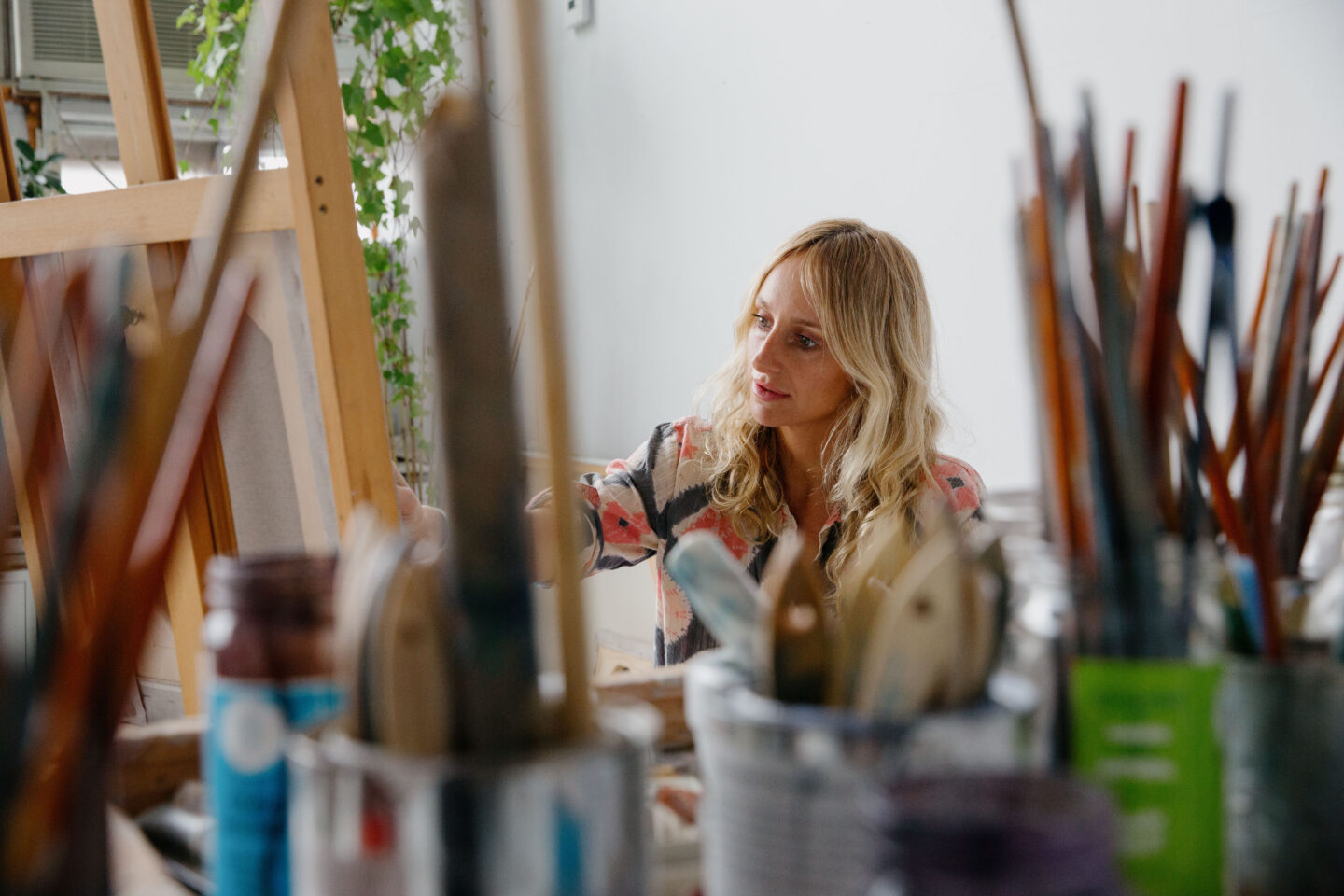
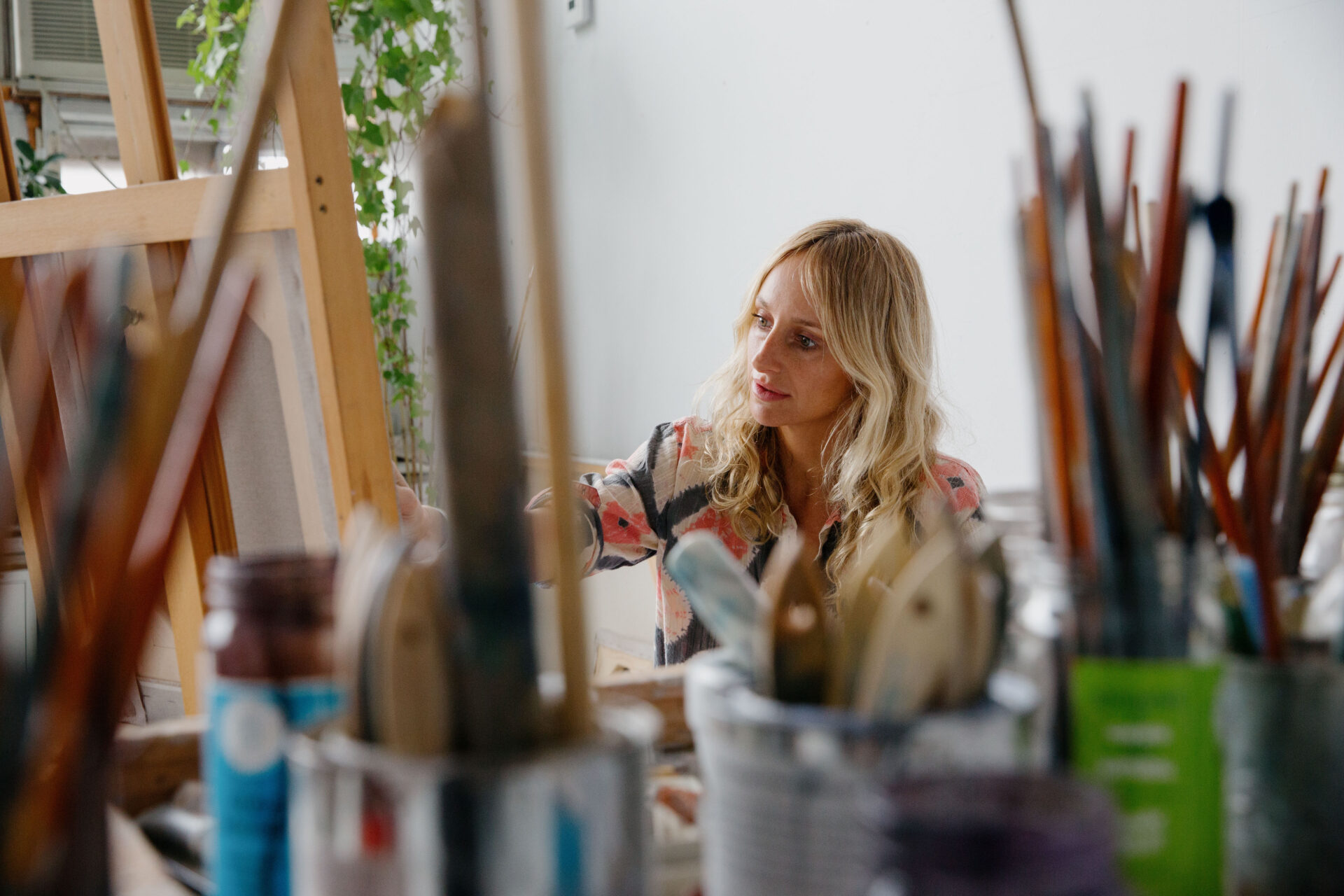
Cover portrait of the artist by Jason Campbell. Image courtesy of the artist.
LVH Art: I would love to start by discussing your upcoming solo presentation with Pace Gallery at the Zona Maco Art Fair in Mexico City. Having spent part of your childhood in Mexico, it must be particularly meaningful to present your work there. How does it feel to be showing your work in Mexico? Did you create these works while in Mexico, or were they painted in New York?
Kylie Manning: It’s a real pleasure to share my work in Mexico. My time spent there as a child was so formative that showing these paintings feels less like an arrival than a return. I gathered pigments in Mexico, including iron-rich oxides, volcanic ash, cinnabar, and malachite, and brought them back to my Brooklyn studio, where all the works were completed, and the pigments were incorporated into the works. I also returned to the Mexican coast over the holidays to rewire my brain in the ocean and revisit the body of work with clearer eyes. The paintings carry Mexico not as an image or subject, but as substance and orientation. Because of the materials embedded in the works, they return physically and conceptually to their resting place.
LVH Art: Have your childhood memories from your time in Mexico played a role in shaping your works for the Zona Maco Art Fair?
Kylie Manning: Yes, absolutely! Memory enters this body of work not as nostalgia but as rhythm and orientation. Mexico taught me early that time is not merely linear – ancestors, residue, and trace coexist with the present. That sensibility shapes how figures misbehave in the paintings – gestures linger, and ghosts hover between here and elsewhere. The work absorbs and recalibrates this within a language of vulnerability and collective endurance.
LVH Art: Could you tell us more about the works you’ll be presenting at Zona Maco?
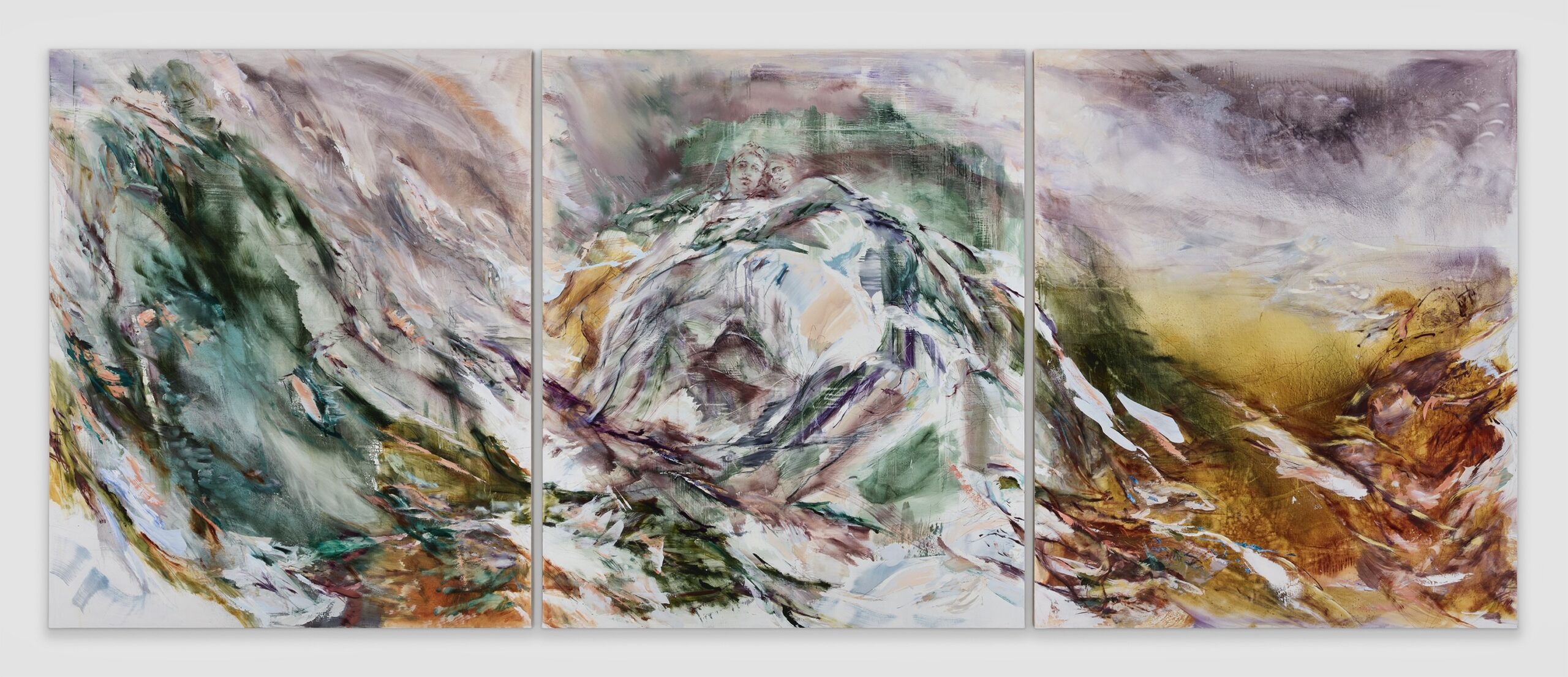
Kylie Manning: In this body of work, the landscape overtakes the figure in a way that differs from my previous works. As figures recede deeper into space, they become entangled with the environment through drawing, erosion, and wash—less depicted than absorbed.
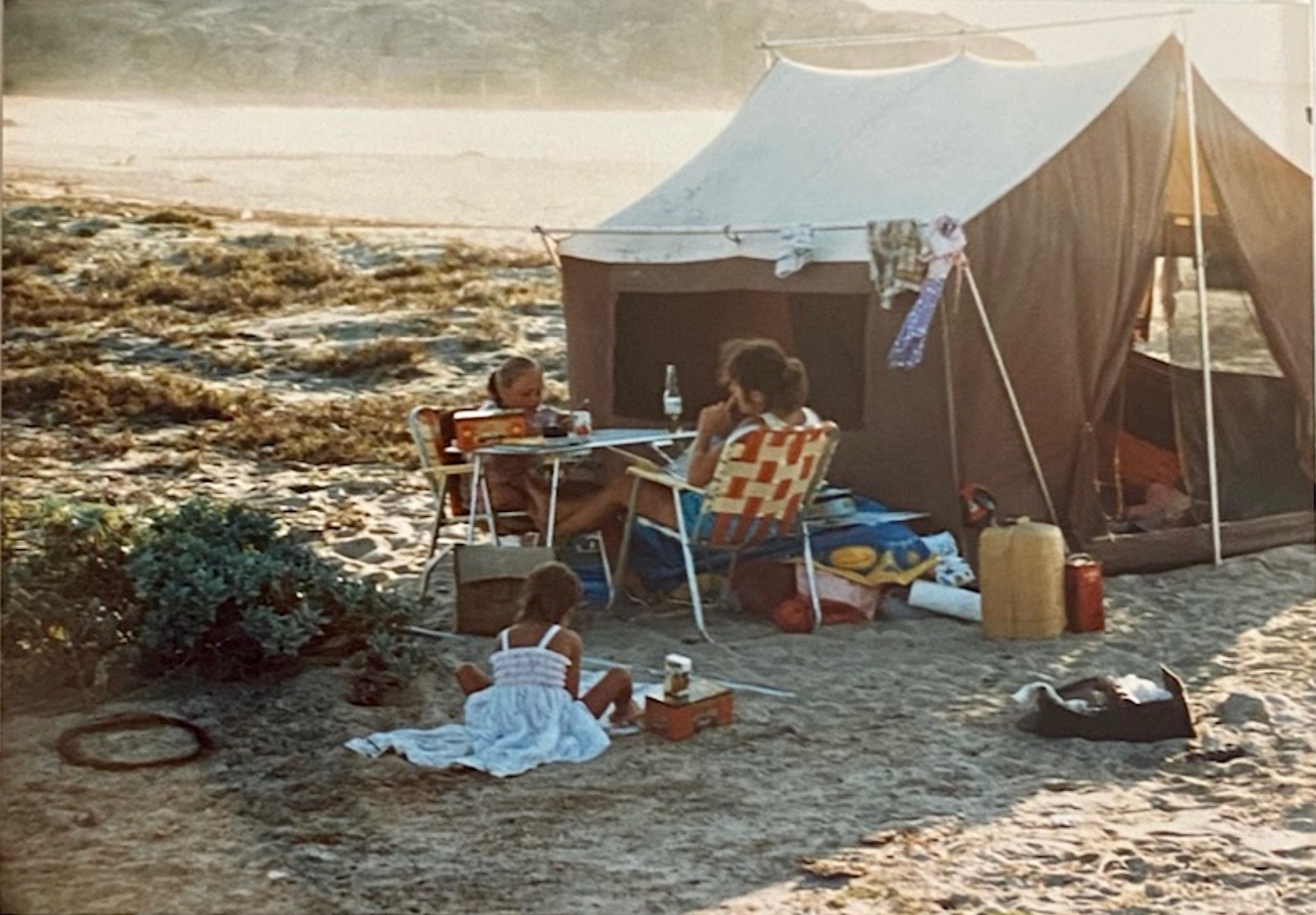
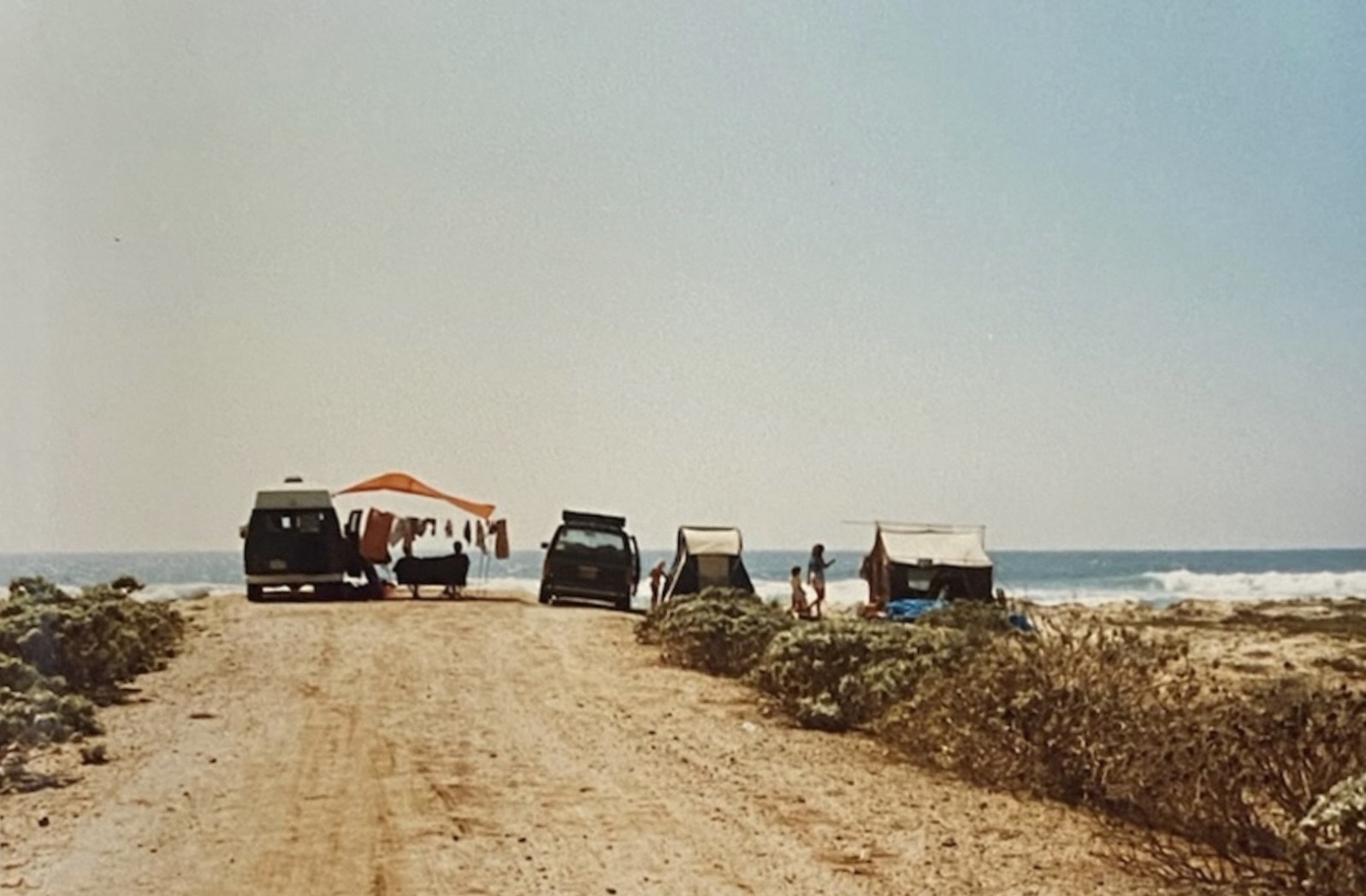
LVH Art: Your paintings are not traditional landscapes, as they are far more atmospheric and emotional, yet landscape clearly plays a central role in your practice. How has being born in Alaska and spending time in various parts of Mexico shaped your work and its approach to landscape? And how have photographs of your childhood inspired your works?
Kylie Manning: Coastal light, maritime labour, and seasonal rhythms shaped my earliest orientation to space. My upbringing balanced elemental vastness with disciplined routine. This outcome comes from being raised on coasts: a landscape painting is the last thing I’m thinking about—and yet the exact knot of the wind is at the front of mind. Landscape, for me, is not a backdrop but a force. Alaska and Mexico offered radically different latitudes, yet both trained my body to navigate the environment through weather. I think you can feel this in the paintings. These geographies—tides, weather systems, working tempos—continue to inform my chromatic restraint and sense of scale.
Family photographs function less as source images than as emotional coordinates. What remains in the paintings is not a depiction, but a sense of home and familiarity in chaotic exteriors—and with that, how one holds on within vastness.
LVH Art: In a past interview, you spoke about how your upbringing introduced the idea of ‘wildness’ to your work. Could you elaborate on what you mean by that?
Kylie Manning: I grew up almost exclusively outdoors. We were told to come back inside when it was dark, and not before. We were in trees so much that my father had to get us red sweatshirts so he could count us in the hemlocks from the surf. ‘Wildness’ is about the freedom of youth, before a girl is limited by societal constraints and can just be. Perhaps I search for that in the paintings.
There’s also a real focus on balance and pacing. Chaos and restraint coexist in the wild, and are juxtaposed in my paintings. If the drawing is frenetic, the composition may be peaceful; if the surface is turbulent, colour might steady it. Growing up in hunting and commercial fishing communities taught me how to navigate with what you had at hand. I want viewers to navigate the paintings more like trackers—following traces rather than details.
LVH Art: Can you walk us through your creative process? Do you have any rituals or routines that help you stay focused and inspired while creating?
Kylie Manning: I’m a work-harder-not-smarter kind of gal. It’s like mining—you dig and dig, and maybe one day you hit something of substance. I recently started to brick (it’s a device that blocks all your apps) my phone, which I’m actually quite thrilled about because now I can only access books and music. My rituals—like an elaborate tea habit, for instance—are about eliminating distractions and setting up the studio to support that. I don’t use assistants and don’t have visits until the work is finished. Solitude is the goal.
Two of my favourite artists, Grace Metzler and Jay Miriam, once talked about immediately taking off their bras and tying up their hair when they arrived at their studios. It felt like the perfect description of how you bind and release in specific ways to make space for flow. I have all kinds of habits to get things moving—preparing surfaces, grinding pigments, mixing paint—and sometimes, if I’m lucky, colour takes off.
LVH Art: Can we discuss your technique in more detail? When did you discover this layered oil process, and what draws you to it?
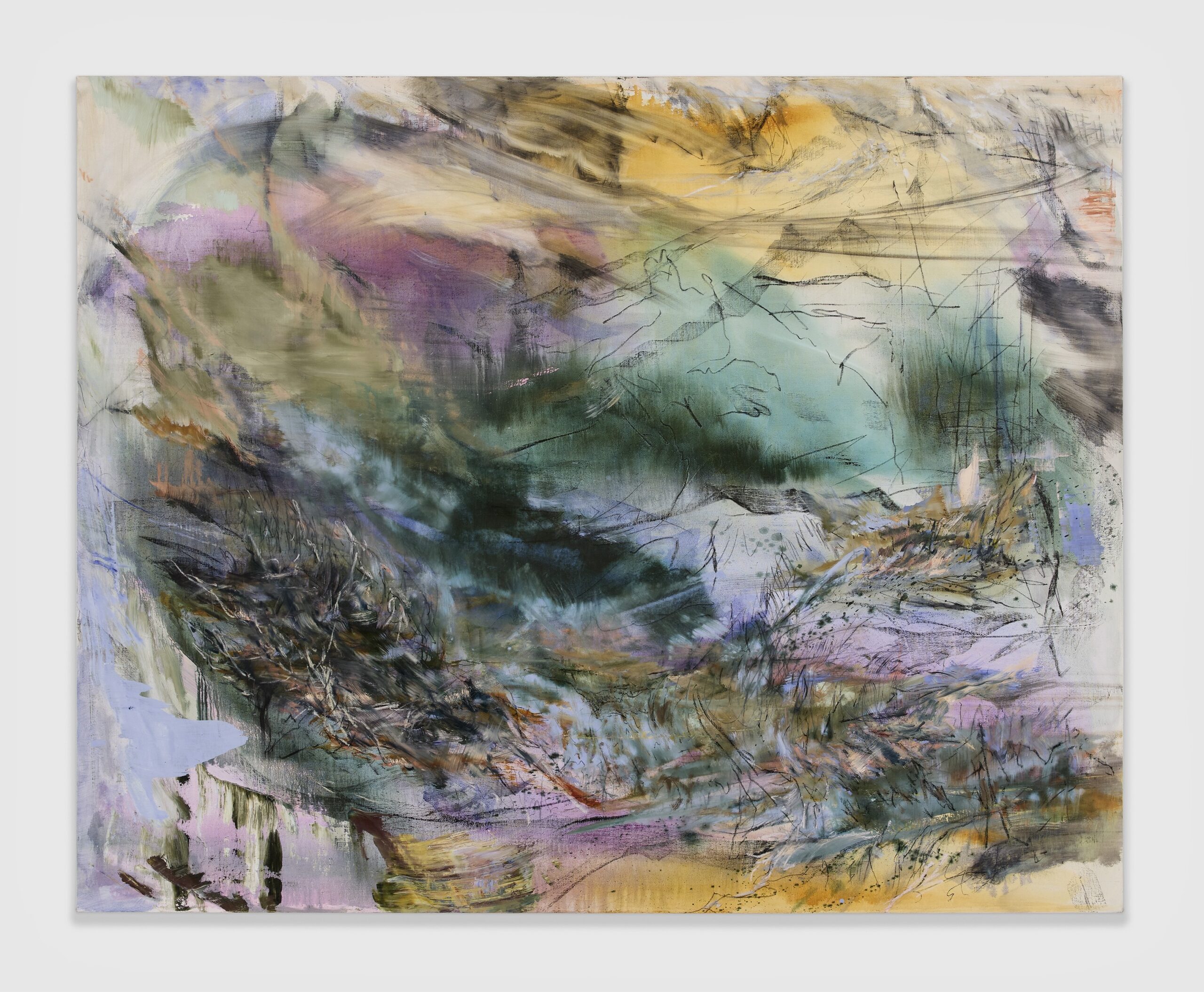
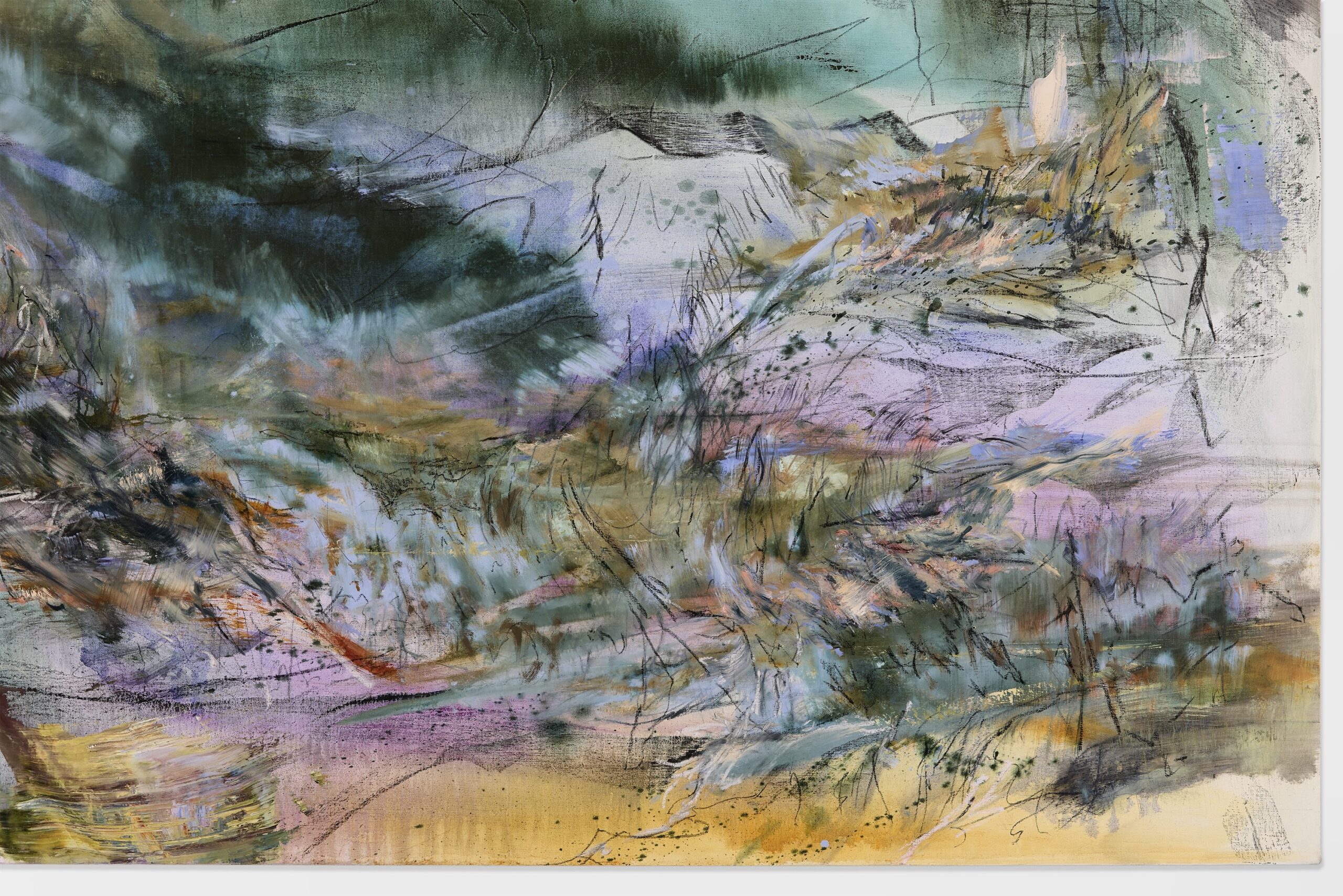
Kylie Manning: I understand painting not as representation but as an event, as a site of accumulated gesture and erasure where presence, care, and vulnerability register through time. In this body of work, I’ve become less an image-maker than a keeper of the tide—carefully navigating pours, stains, and material drift that bury information and allow forms to re-emerge. Meaning and balance surface through submersion. Orientation replaces depiction.
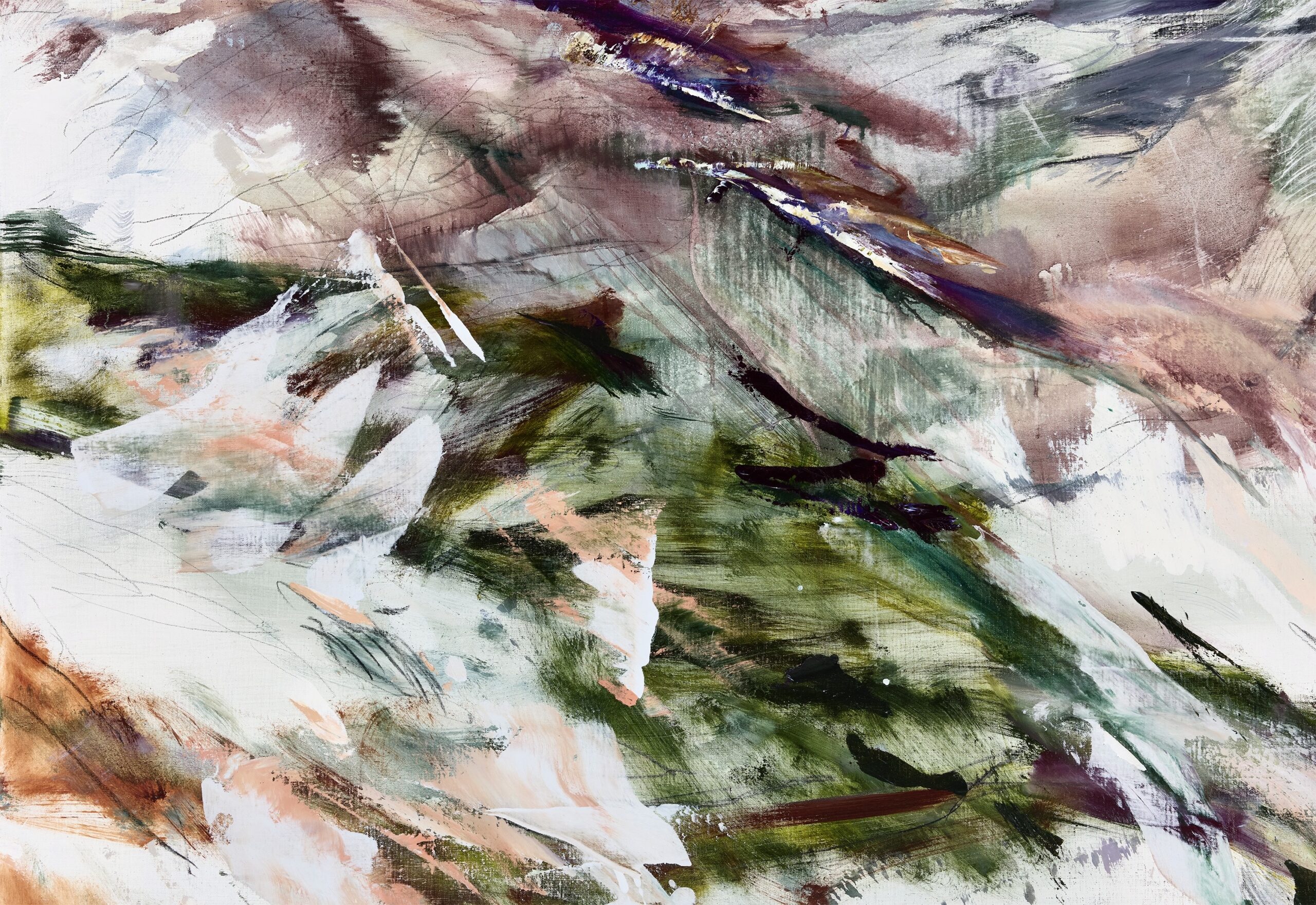
The process is durational and physical: pouring, staining, scraping, sanding, and wiping—accumulating and erasing until forms begin to crystallise. Grinding pure pigments and separating layers with oil allows light to refract and time to register. The method echoes Dutch Baroque practices, but I’m less interested in virtuosity and more interested in what energy is imbued in a material; therefore, where the pigment comes from has become increasingly important to me over the years.
LVH Art: Do other art forms, like film or writing, inspire your work?
Kylie Manning: Absolutely – All of them!
LVH Art: Your work often navigates the space between figuration and abstraction. Is this balance something you are conscious of while painting, or does it come more organically?
Kylie Manning: I don’t think in terms of figuration versus abstraction, but in terms of density and pacing. Abstraction isn’t a goal; it’s a condition that emerges through tidal burials and editing. Figures appear through pareidolia, registering as presences rather than images—structural anchors that hold a work together as perceptions shift and redistribute over time.
LVH Art: When figures emerge in your works, their origin, gender, and actions often remain ambiguous. What draws you to this ambiguity?
Kylie Manning: Paint is already a universal language, so specificity, by its nature, is limiting. Arbitrary limitations annoy me, so intentional ambiguity allows the figures to hold collective experience. The bodies, if any are found, are not portraits but presences. These ghosts are bound by endurance—moving together, pulling one another out of the mud, entangled, and bearing one another with care.
Mexico City Now: Artists, Galleries, and the Pulse of a Global Art Capital
Mexico City Now: Artists, Galleries, and the Pulse of a Global Art Capital
From Tradition to Form: Mexico’s Design Landscape Today