Sculpting the Cosmos and Shaping Time in the works of Alicja Kwade

Alicja Kwade has built a poetic and hypnotic body of work across multiple series, repeatedly returning to the same philosophical questions while shifting materials, forms, and spatial arrangements. In this article, we delve into her most significant series to examine how her sculptures make the world feel unsettled and unstable, but in ways that expand our sense of possibility and deepen our understanding of the systems that shape reality.
Alicja Kwade (Katowice, Poland, 1979), who lives and works in Berlin, investigates the structures that shape our reality, examining how we perceive both the world around us and the passage of time. Her practice probes the instability of perception and reveals the constructed nature of the social systems we depend on, prompting viewers to reconsider what they accept as true. One of the most important materials in her practice is stone. She employs stones in many forms, sometimes smooth, rough, carved, or polished, using them not only for their physical properties but also for their conceptual depth. “Stones are compressed time,” she once remarked, capturing the way geological material contains vast histories within it. For Kwade, stones represent accumulated time and the shared material foundation of human existence, as earth is also in many ways compressed stone.
Kwade also frequently pushes the boundaries of what is technically possible, working closely with engineers to realise works that require complex fabrication. Her sculptures rely on precision, balance and structural ingenuity, and her collaborations with engineers allow her to create effects that appear to defy logic. In an interview with the Louisiana channel, Kwade boldly said, “I would describe myself as an absolute non-believer. I don’t believe in anything. I don’t even believe in this chair that I’m sitting on. It’s not actually there; it’s just empty space. I am a relativist.” Kwade, through her works, invites the viewer into a space where knowledge is no longer fixed, prompting us to question everything. In this state of uncertainty, we allow ourselves to become curious and open to other worlds, new perspectives, and wonder.

Be-Hide
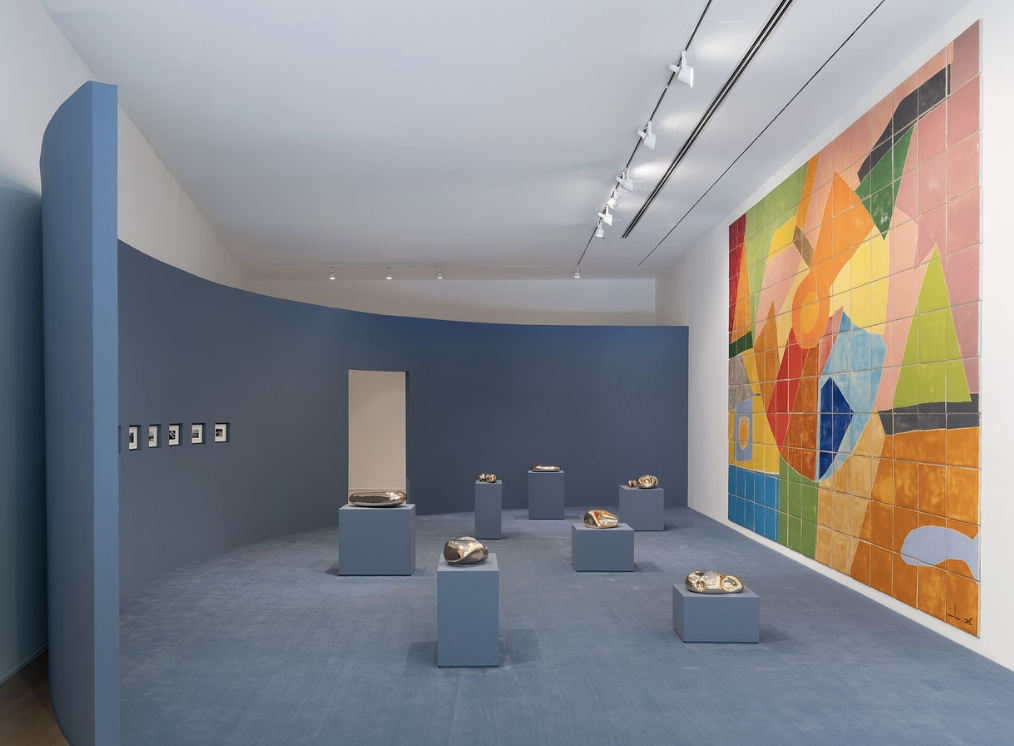
In Kwade’s Be-Hide series, she places two-sided mirrors between stones, multiplying the stones through reflection, and destabilising the viewer’s sense of what is real. At certain angles, the mirror may reflect the environment, expanding the viewer’s surroundings; other times, the stones appear fragmented or doubled, or at certain angles even look as though the stones are merging in real time. The work cannot be fully understood from a single viewpoint, and the Kwade’s work encourages the viewer to move around it, constantly shifting their position to change the entire nature of the work. As the viewer moves around the sculpture, the mirror continually shifts between acting as a reflective surface and a transparent window, causing the original stone and its replica to appear as interchangeable reflections. This creates a “game of hide-and-seek.” The title “Be-Hide” itself gestures toward Kwade’s conceptual intentions: the stone exists in real space (“be”), yet the mirror complicates this existence by making parts invisible (“hide”). In this series, the mirror becomes a tool for transforming stable real-world objects into unstable conceptual tools. She has done multiple iterations of this series, some more monumental, titled “Big Be-Hide” and some more intimate in scale, titled “Little Be-Hide.” She has also created a few versions where she incorporated additional stones and mirrors, creating more complex installations that also introduce questions around parallel realities.

Pars Pro Toto
In Pars Pro Toto, multiple perfect spheres of varying sizes and materials are grouped in proximity. The title is Latin for ‘a part for the whole,’ reflecting the philosophical relationship between individual elements and the larger systems they comprise. Each sphere, made from stones sourced from different parts of the world, can be seen as a microcosm of the universe, or a single part representing a larger whole. At the same time, the meaning of each sphere emerges from its relationship to the other spheres and the installation as a whole. If they were single spheres, they would not create the same meaning. The “whole,” or the entire installation, gives context and significance to each “part” (the individual spheres), while each part also contributes to your understanding of the whole. Also, when encountering this work, viewers are faced with the contrast between individual existence and the vast scale of time and matter. Kwade does not paint any of the stones or disguise them as something different; instead, she opts to keep the lines on the stone visible, revealing the literal manifestation of pressure over time. The stones are carved into perfect spheres, simultaneously evoking planets and atoms. Kwade has often explained that her work seeks to connect the monumental with the microscopic, capturing the vastness of the universe while also invoking the scale of atomic structures.
A recurring motif in Kwade’s work is the circling system or the idea of forms repeating into infinity, which is echoed here in the sphere appearing in various sizes. As she has explained in an interview, she continually returns to this imagery because the matters she is dealing with are “time, space, gravity, and that automatically brings you into a circulation.” Kwade strives to keep her works open-ended, encouraging viewers to engage their imagination and derive a range of interpretations. In an interview, she noted that when looking at Pars Pro Toto, she envisions God playing marbles, and she hopes the work prompts people to question the randomness of human existence. One work from this series was shown in the Arsenale at the 2017 Venice Biennale. It featured twelve meticulously selected stone spheres arranged like a family of planets momentarily frozen in orbit. In this iteration of the series, Kwade also incorporated an audio recording from the Voyager Golden Record, produced in 1977. The soundtrack, intended for extraterrestrial civilizations and future humans, was designed to communicate the richness and diversity of life and culture on Earth, adding a further conceptual bridge between the physical presence of the stone spheres and the broader narrative of human curiosity, communication, and our desire to situate ourselves within the cosmos.


Siège du Monde (Seat of the World)
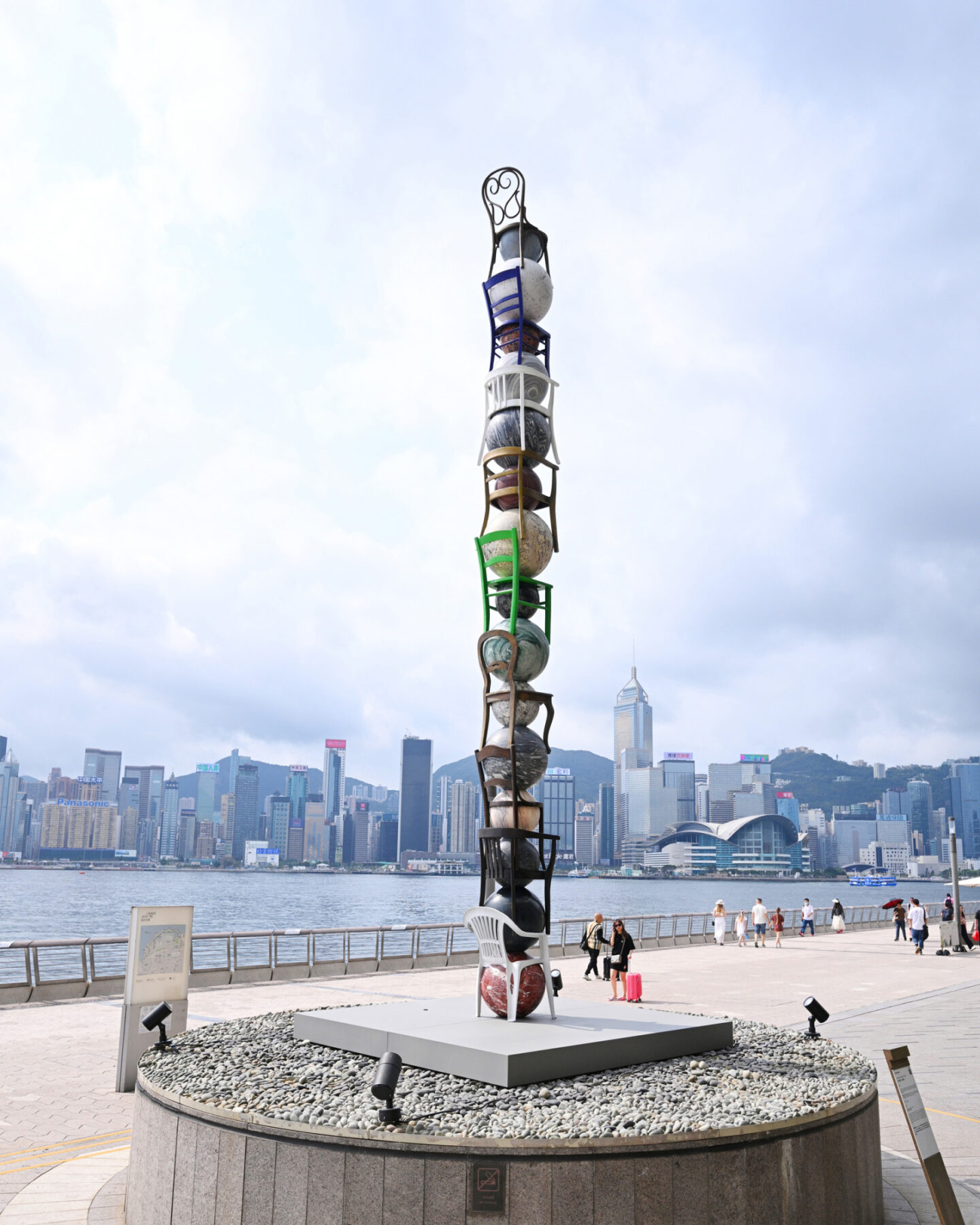
Alicja Kwade’s Siège du Monde (“Seat of the World”) is a sculpture that brings the intimate into dialogue with the cosmic. In this series Kwade pairs a simple, everyday chair with a polished sphere of marble or stone. The chair, a familiar and practical object that invites viewers to imagine their daily lives, is set in contrast to the enigmatic sphere, which evokes the planet or the broader universe. By combining classical materials like marble with ordinary objects and materials, like a wooden or plastic chair, Kwade unsettles familiar forms, challenges assumptions about reality, and prompts reflection on our place in the cosmos. The work functions as a metaphor for humanity’s desire to understand, dominate, or symbolically “sit upon” the world, yet its positioning either under or through the chair introduces irony and restraint. Kwade emphasises the absurdity of human ambition: we dream of mastering the world yet remain constrained by our limited perception and physicality. The work encourages viewers to consider the interplay of desire, power, and reality. As Kwade has observed, “We are really poor animals in a way… we are able to ask the questions, but too stupid to get the answers.”
The title L’ordre des mondes references Piero Manzoni’s 1961 bronze Socle du Monde, whose inscription can only be read upside down, causing the pedestal to appear inverted and serve as the foundation of the world. Drawing on this conceptual idea, Kwade’s series engages with profound themes in a likewise playful manner, suggesting with a touch of humour that we all fantasize about sitting on the globe and contemplating the universe. The series includes multiple iterations: sometimes a sphere sits beneath a chair, sometimes the chair balances atop it, and sometimes multiple chairs and spheres are combined.


Against the Run & Entropie
Kwade’s work challenges reality and conventional systems, often examining time and how we measure it. Two of her series that do this are “Against the Run” and “Entropie.” In her series Against the Run, Kwade transforms a familiar clock into something almost “unusable,” raising questions about perception and convention. While the clocks technically show the correct time, they deliberately confuse the viewer: as the hands move clockwise, the face rotates counterclockwise, creating a subtle perceptual trick. Through this manipulation, Kwade invites reflection on our reliance on arbitrary systems, such as the measurement of time in daily life. In Against the Run (2023), she created a commission for the Pista 500, which is the track historically used by the FIAT factory for testing cars on the roof of the Lingotto building, which now also houses the Pinacoteca museum. For commissioned works, she often adapts the clock to its specific location. For this Pista 500 commission, Kwade’s design drew on the clocks historically used in FIAT factories, where timekeeping measured workers’ productivity. The work also subtly references the famous “clock’s hands strike” of 1920, when FIAT Brevetti workers collectively set the clocks back by an hour to protest daylight saving time. A century apart, the workers’ actions and Kwade’s intervention both reflect on time as a human construct, revealing the fragility of progress and questioning the stability of the systems that structure our lives.
In her series Entropie, Kwade arranges immobile watch hands on paper, often plated to appear gold against a white background. The metallic plating not only creates a striking visual effect but also adds a symbolic layer, referencing the idea of time being valuable. Each work corresponds to a specific span of time measured in days or hours, with the number of hands increasing in proportion to the duration represented. Kwade developed the series during lockdown, treating it as a diary of sorts. As she explained in an interview, “I tried to create one piece every day and record the passing of time as it appeared to me, because these lockdowns have changed my perception of time extremely. All travelling suddenly stopped, projects were frozen in process, everything became very slow and at the same time extremely fast; a standstill race.” During lockdown, she studied the system of time itself, asking questions such as “why are there twelve numbers?” and “why are there numbers at all?” She searched for patterns in her research and tried to connect her results to light. She saw that when the clock’s numbers are reinterpreted in a linear arrangement, the watch hands form patterns reminiscent of light or sine waves. The concept of entropy, a scientific measure of a system’s disorder or randomness, underpins the work. Although the arrangement of the clock hands may initially appear structured or rhythmic, there is an underlying sense of disorder. The clocks are motionless and functionally meaningless as timekeeping devices. Kwade’s work invites reflection on the human impulse to measure and order time, while reminding us that these systems are ultimately constructs.
ParaPivot
In ParaPivot, large, intersecting steel frames support suspended stone spheres that seem perpetually on the verge of movement, as if the entire structure were an unstable solar system caught in mid-orbit. She made one monumental version of ParaPivot for her commission for the Metropolitan Museum’s Roof Garden in 2019 (seen in the image window above). Kwade described the experience of installing it as “placing a hat on top of all we have achieved in the last thousands of years.” At first glance, the geometry is striking: crisp squares and rectangles intersecting with perfectly smooth spheres. The angular steel structures evoke a human-made system, framing the jagged Manhattan skyline as though it, too, were part of the composition. Against this rigid architectural frame, stone globes gathered from all over the world, each one carrying its own geological biography.
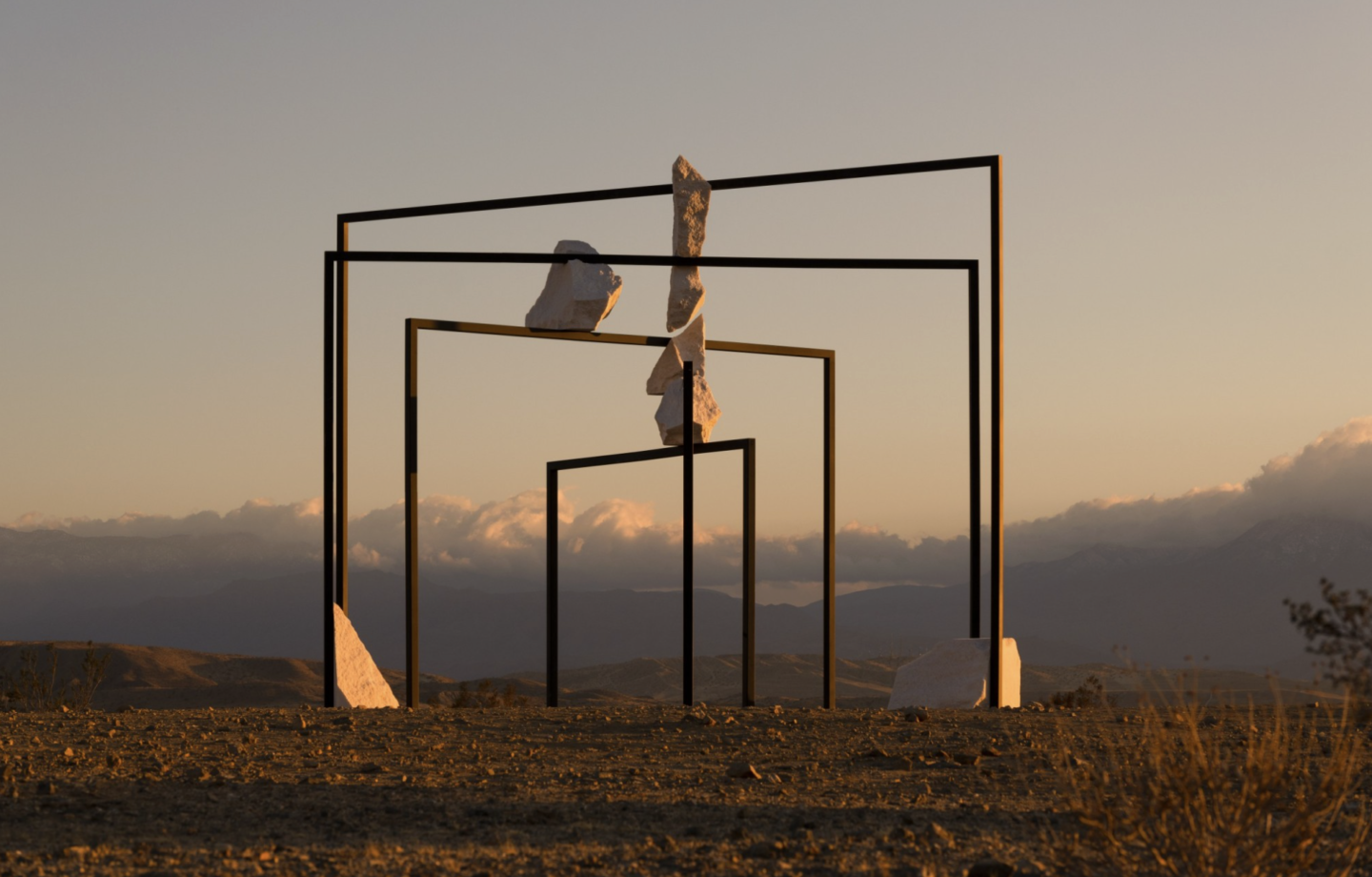
Kwade created another iteration for this series, ParaPivot (sempiternal clouds) for Desert X in 2021. Here, instead of smooth stone spheres, massive blocks of white marble appear like fragments of glacier ice transported from another world. As viewers move through and around its frames, the sculpture seems to shift in response, echoing an experiential version of Heisenberg’s uncertainty principle. The act of observing subtly alters what is being observed, creating an illusion of perpetual instability. The steel appendages radiating from the structure’s central points seem to trace an invisible orbital path, recalling the early scientific instrument used by Greek and later Islamic astronomers to map the positions of stars and planets. It evokes humanity’s ongoing attempt to chart the universe and to understand our shifting place within it.


Revolution Orbiter (or Freiheits Grad)
In Revolution Orbiter, Kwade builds on ideas explored in her ParaPivot series, but instead of placing stones along rigid, linear frameworks, she sets them within sweeping circular formations. This shift from straight lines to orbits amplifies her investigation into gravity and motion, pushing the limits of what can be physically balanced and held in place. The work becomes a finely tuned negotiation between opposing forces, a fragile equilibrium. The German title Drehheitsgrad, meaning “degree of freedom,” refers to the range of movement an object possesses, though here the stones are tightly constrained. They rely on absolute precision to remain suspended, even as their configuration creates the illusion of dynamic, continuous rotation. Kwade invites viewers to feel this tension and reflect on the idea of freedom itself—particularly the way our own movement through the cosmos is fixed, our orbit predetermined long before we are born. For Kwade, gravity is both the essential force that anchors existence and a paradoxically weak one, easily countered by the human hand. Circularity, orbital patterns, and the suggestion of motion recur throughout her sculptures, reminding us of the unseen forces and predetermined trajectories that silently structure our lives.
Kwade’s sculptural language demands that viewers move, look closely, and confront the assumptions they carry into the act of seeing and in their ways of being. As she herself notes, her practice is ultimately an exploration of how objects, and our understanding of them, transform over time. By probing who defines reality, how our senses constrain us, and how perspective reshapes what we consider “objective,” Kwade reminds us that reality is never fixed. It is negotiated, contingent, and inseparable from the subjective experience of the observer. Kwade’s works make the world feel unsettled and unstable, but in a way that opens it up to new possibilities.
Mexico City Now: Artists, Galleries, and the Pulse of a Global Art Capital
Mexico City Now: Artists, Galleries, and the Pulse of a Global Art Capital
From Tradition to Form: Mexico’s Design Landscape Today