Turning Words into Art: Lawrence Weiner and His Enduring Legacy

Lawrence Weiner (1942–2021) was one of the most influential voices in Conceptual art, emerging in the late 1960s as a pioneer who redefined the role of the artist and the nature of the artwork itself. His practice proposed a new relationship between art, its maker, and its audience, dismantling long-held notions of ownership, creation, and permanence.
Conceptual art, which emerged in the 1960s, is founded on the principle that the idea behind a work holds greater importance than its physical form. Recognised as one of the movement’s leading figures, Weiner turned to language as his primary medium in the late 1960s. His works, most often presented in a clean sans serif font, frequently refer to materials and constructions that suggest a physical process. While he did not define his practice as site-specific, each piece develops a distinct connection with the place in which it appears. Whether situated in a public square, on a gallery wall, or within the pages of a book, each context offers viewers the opportunity to form their own interpretations through their personal experience.
Like much of Conceptual art, Weiner’s works do not require the artist to physically execute them. In rethinking the traditional dynamic between maker and viewer, he placed responsibility for the work’s realisation into the hands of its audience. Over the course of his career, his engagement with language evolved from describing straightforward actions to employing ready-made verbal structures such as aphorisms and sayings, each highlighting the inherently subjective nature of interpretation.
Biography
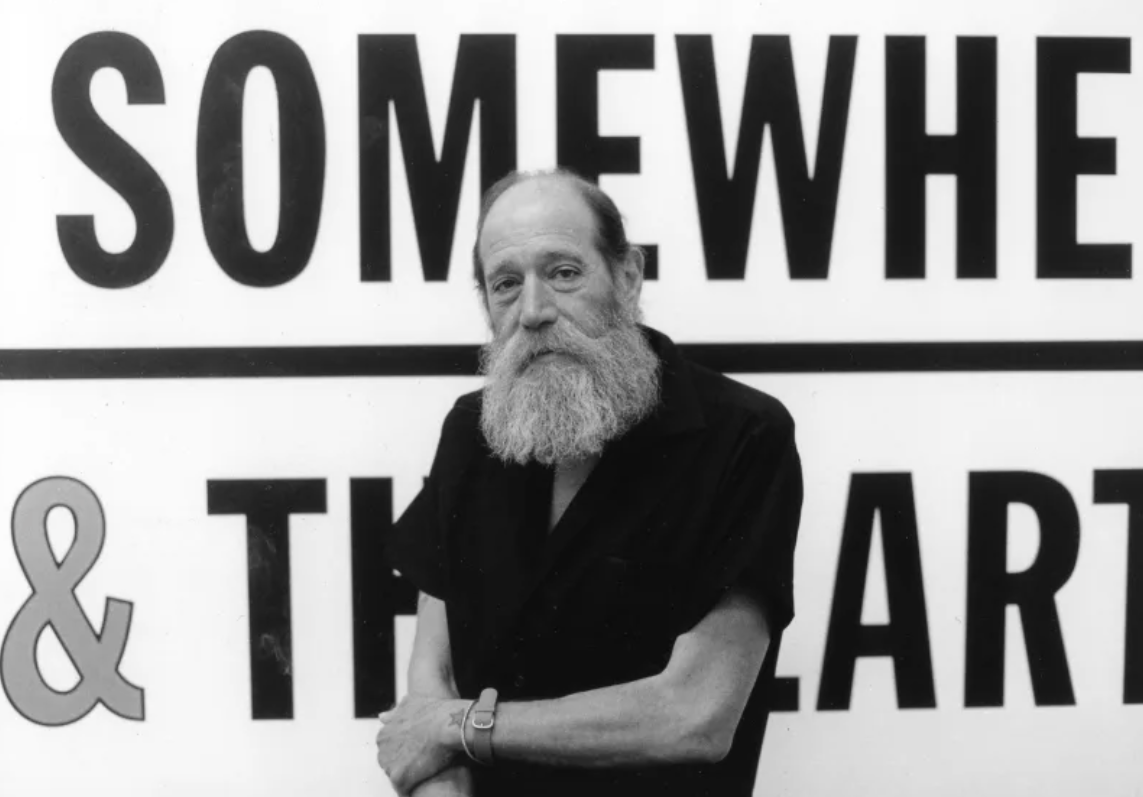
Born in 1942 in New York, Lawrence Weiner lived and worked in the city for most of his life until his death in 2021. He had no formal art school training, a fact that perhaps contributed to the independence of his approach. Before focusing on language, he explored painting, constructed works, and sculpture. In 1970, he discovered a houseboat in Amsterdam that became his second home, and for decades afterward, he divided his time between Amsterdam and New York City.
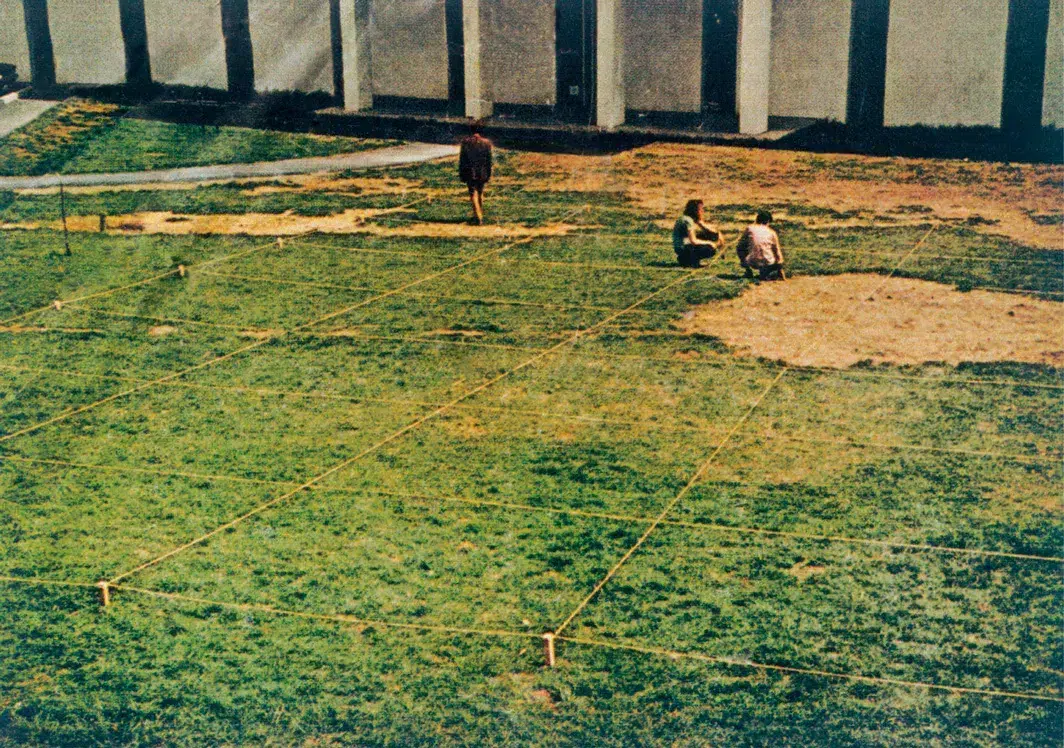
In 1968, Weiner reached a pivotal moment in his practice during an outdoor exhibition at Windham College in Vermont, organised by Seth Siegelaub. He created a sculptural installation marking a large rectangle on the campus lawn with wooden stakes and twine, within which a smaller section was designated as “removed,” a conceptual subtraction defined by absence. Before the exhibition concluded, students cut through the twine to take a shortcut across the lawn. Confronted with the disappearance of the physical work, Weiner realised its essence remained intact when expressed in words, leading him to regard the idea as equal to its material realisation and to shift toward language as his primary medium.
That same year, he wrote his now-famous Statement of Intent, a foundational text in conceptual art, which states: 1. The artist may construct the work. 2. The work may be fabricated. 3. The work need not be built.
This statement not only codified his break from object-based practice but also redefined the artist–audience relationship, placing equal value on conception and execution.
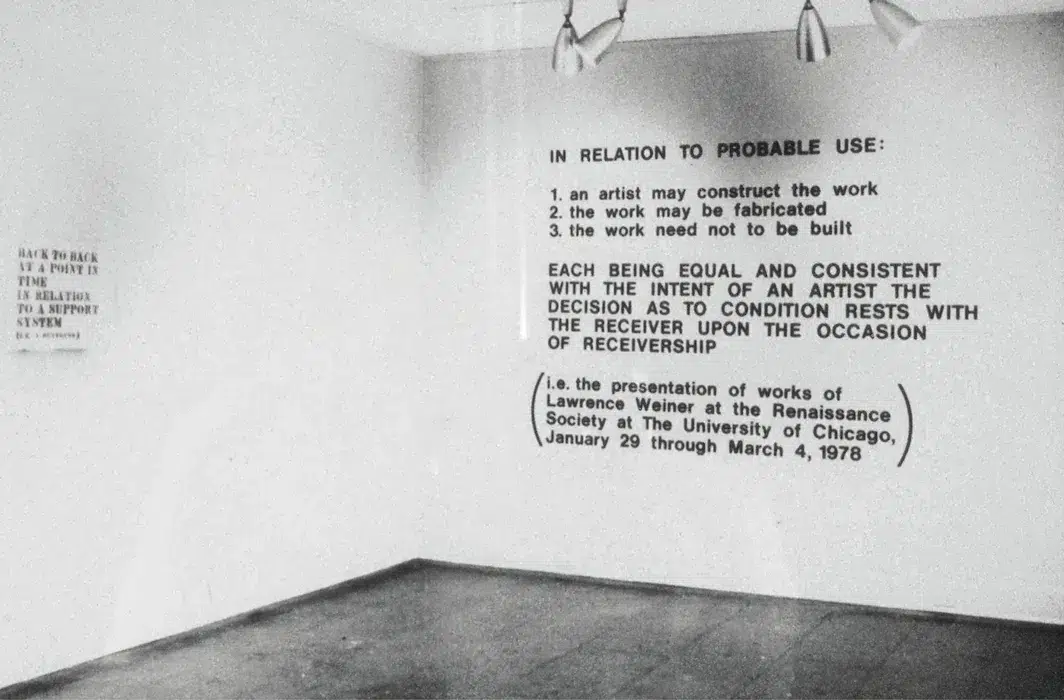
Throughout his career, Weiner maintained a strong presence in both institutional and public contexts, producing works that often bridged the gap between the gallery and the street. Public space, in particular, became a vital arena for his practice. His texts appeared on the façades of buildings, on functional infrastructure, and in ephemeral printed matter such as matchboxes, entering the visual environment of daily life without the framing devices of the museum. These interventions were not conceived as site-specific in the traditional sense, yet they inevitably developed layered relationships with their surroundings, shaped by cultural, linguistic, and architectural contexts.
A selection of our favourite works by Weiner
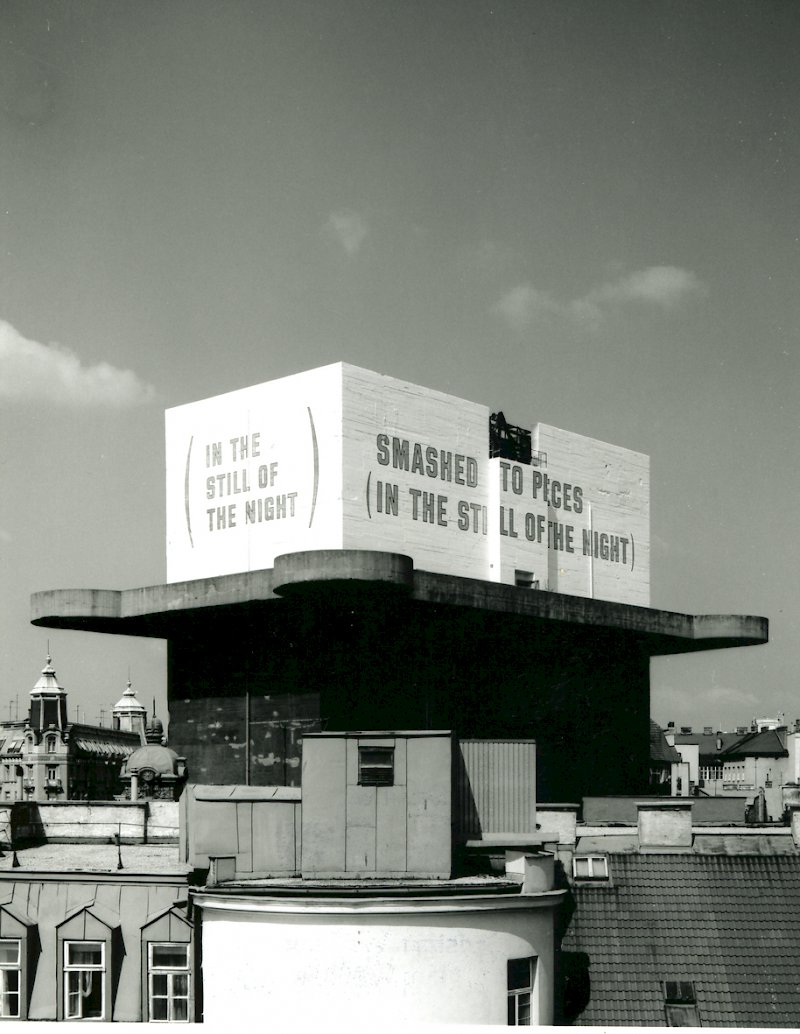
His public projects, SMASHED TO PIECES (IN THE STILL OF THE NIGHT) (1991–2016), was emblazoned in both English and German on the side of a former Nazi flak tower in Vienna. The work, visible from a great distance, confronted the site’s historical weight while remaining open to multiple readings, its terse phrasing shifting between metaphor, memory, and political commentary.
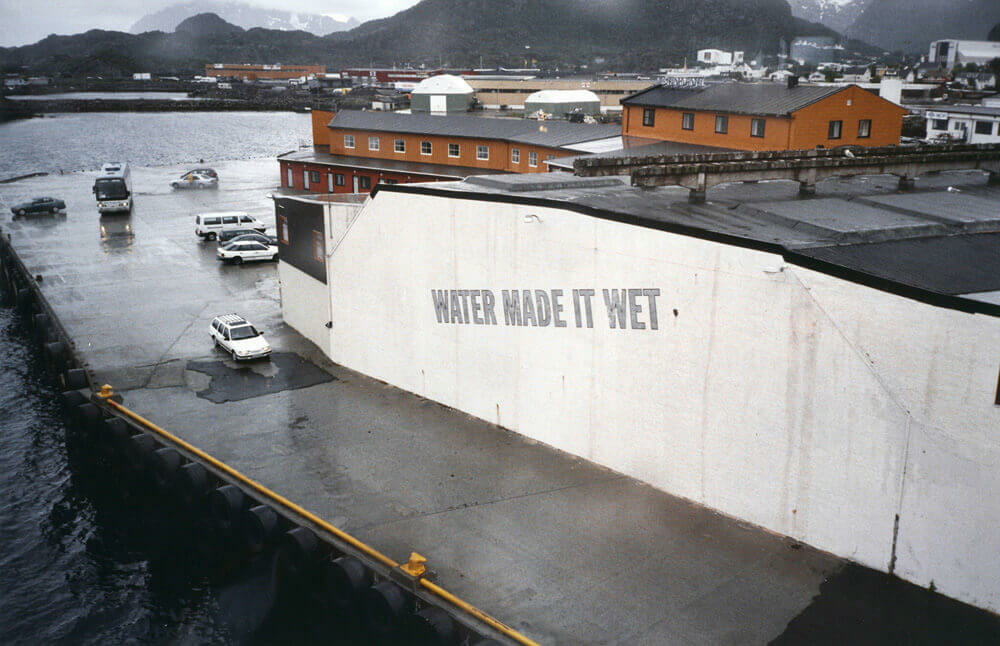
WATER MADE IT WET (1998) was created for the Lofoten International Art Festival in Svolvaer, Norway, an intriguing work installed on the facade of a building in the town’s harbour. The text, deceptively simple, reads just as the title: “WATER MADE IT WET.” Its tautological phrase highlights Weiner’s talent for distilling common observations into poetic and conceptual propositions. Placed in the coastal environment of Lofoten, the statement becomes both humorous and profound, drawing attention to water’s intrinsic qualities while anchoring the work in its literal and conceptual context.
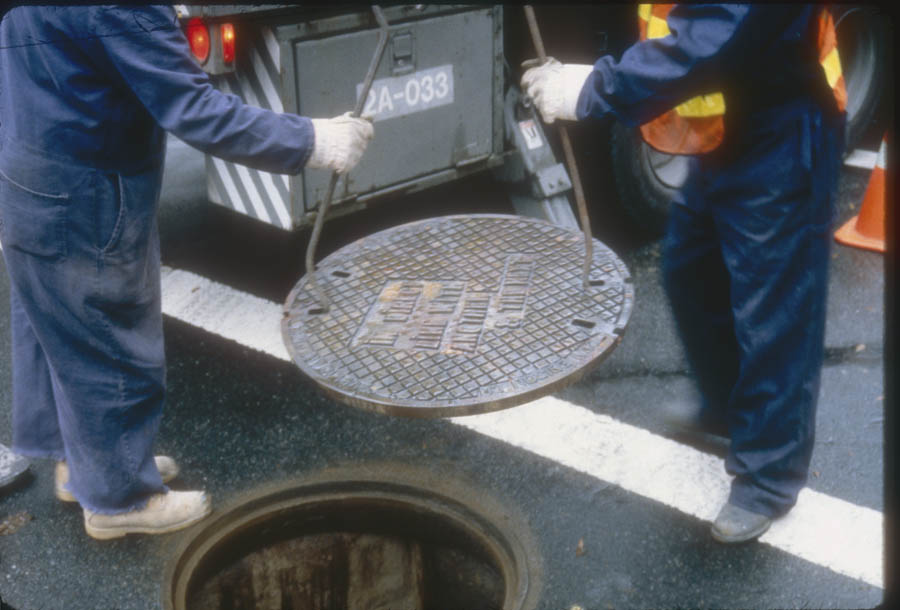
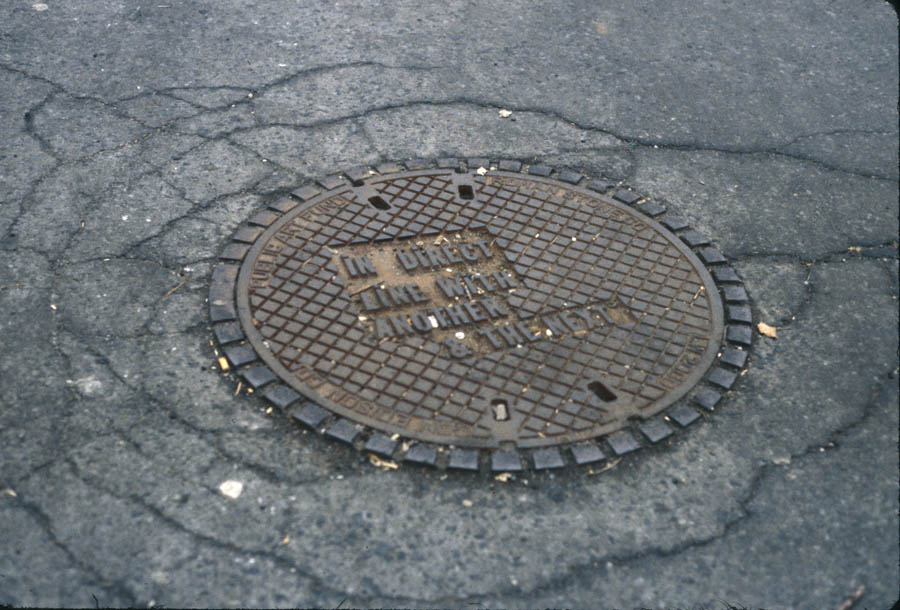
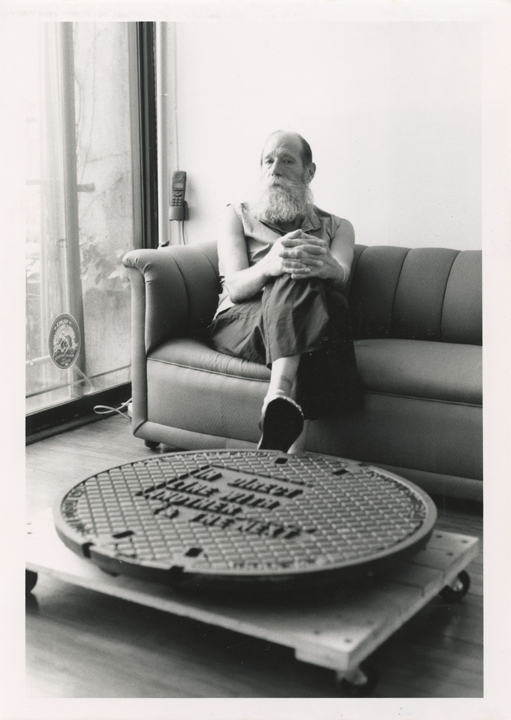
In 2000, working with the Public Art Fund in New York, Weiner produced IN DIRECT LINE WITH ANOTHER & THE NEXT, a work literally embedded into the city’s infrastructure. Nineteen functional manhole covers were cast with the phrase, distributing the piece across the urban grid so that it was encountered unexpectedly in the course of daily movement.
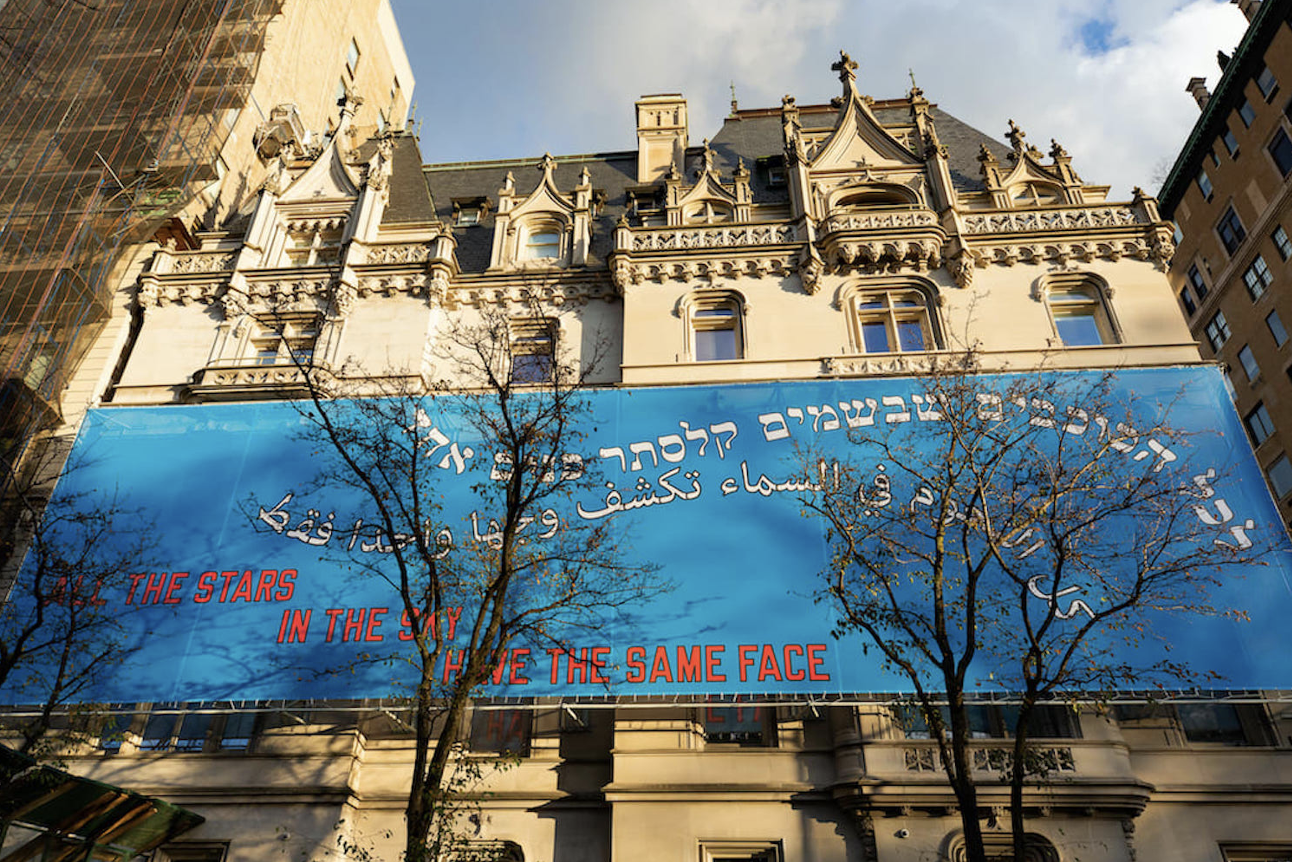
His ability to adapt language to the specificity of place was also evident in ALL THE STARS IN THE SKY HAVE THE SAME FACE (2020–21), commissioned for the façade of the Jewish Museum in New York. Rendered in English, Arabic, and Hebrew, the work operated simultaneously as a poetic assertion of shared humanity and as a subtle meditation on translation, difference, and commonality.
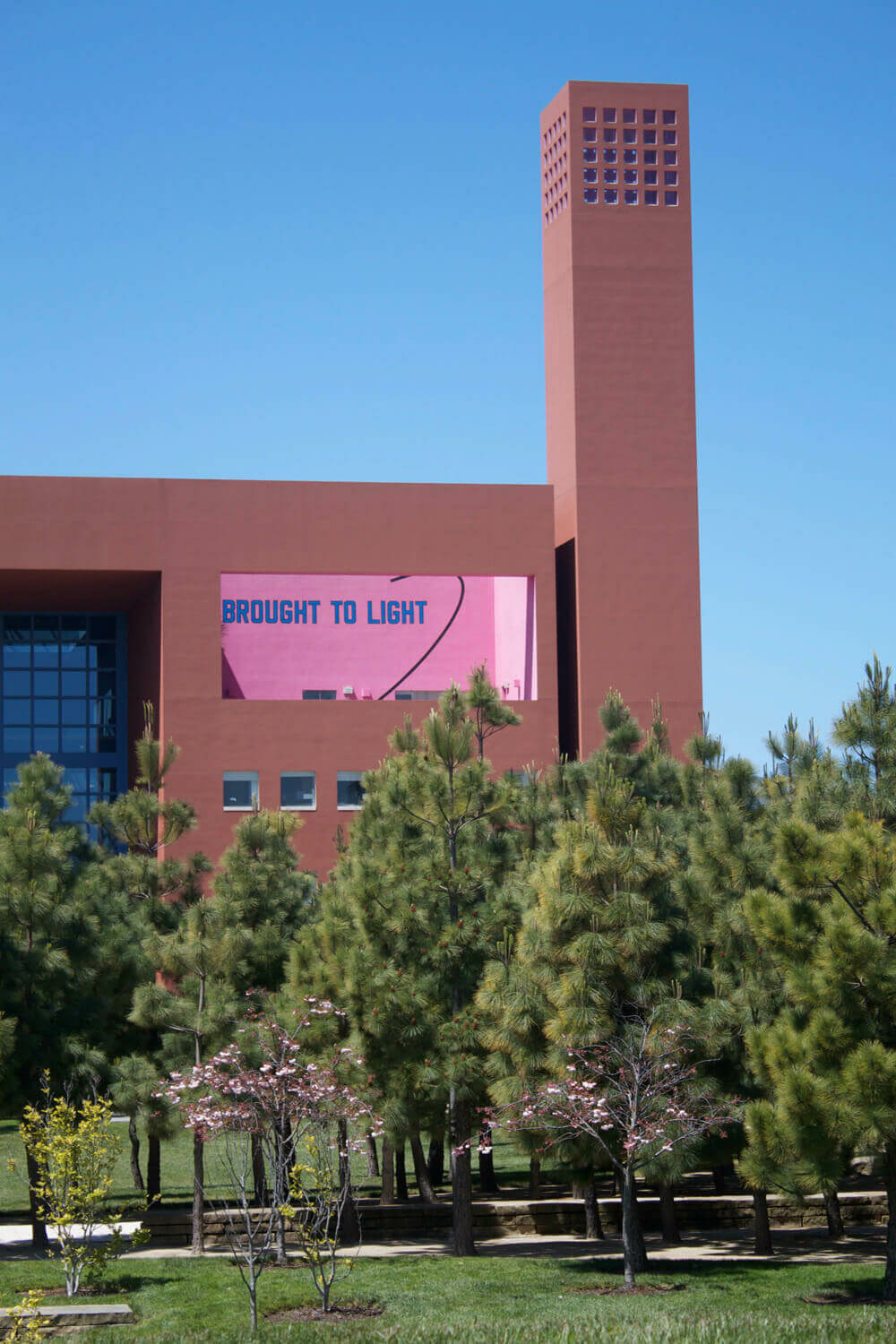
In BROUGHT TO LIGHT / SUBSEQUENTLY ALLOWED TO DISSIPATE (2009), created for the University of California, San Francisco, Weiner staged a layered interplay between revelation and disappearance. The rooftop phrase BROUGHT TO LIGHT, visible from surrounding streets, was paired with rusting steel disks on the plaza below bearing SUBSEQUENTLY ALLOWED TO DISSIPATE. Together, they formed a meditation on temporality, presence, and the shifting states of knowledge.
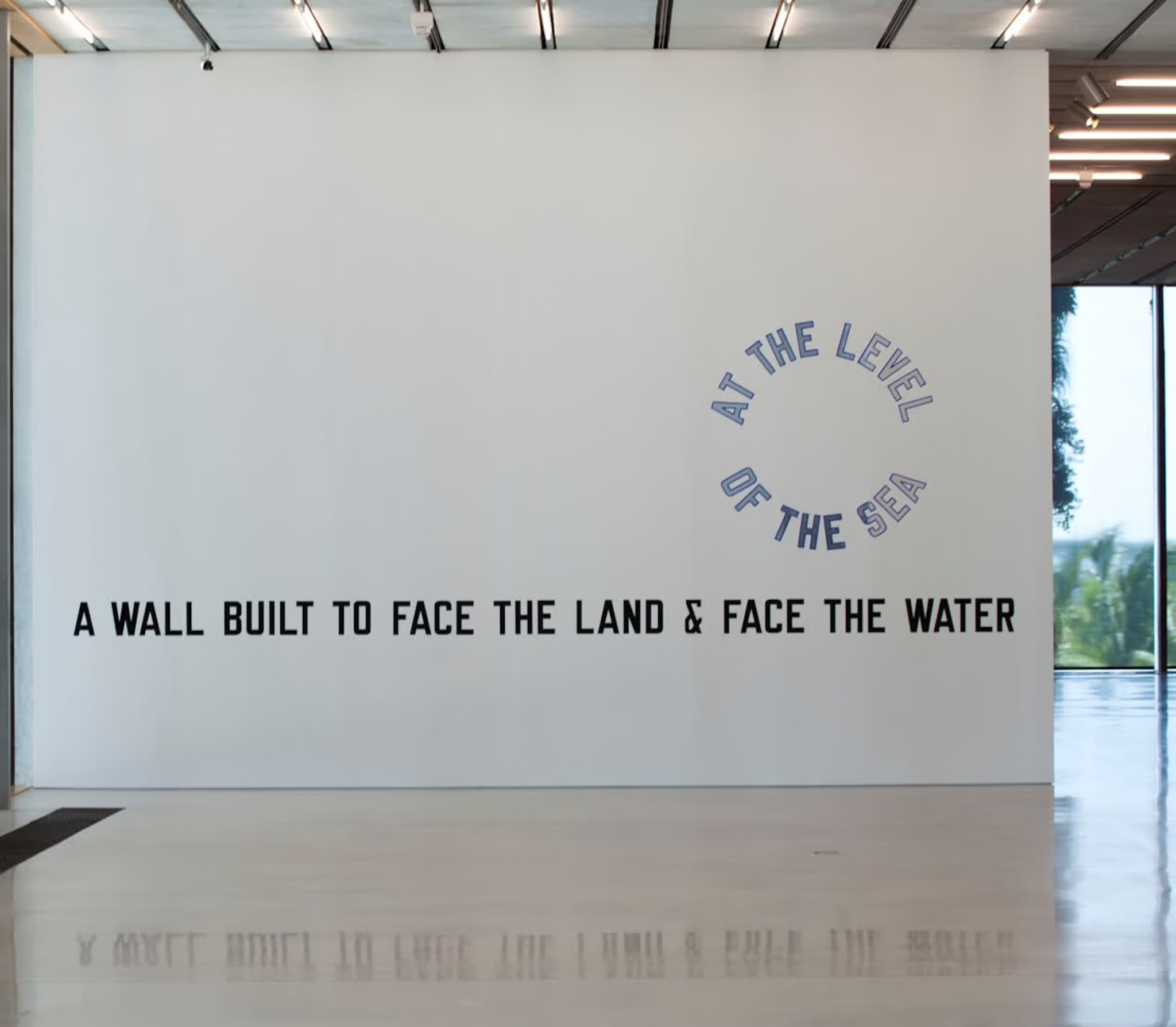
A WALL BUILT TO FACE THE LAND & FACE THE WATER AT THE LEVEL OF THE SEA (2008) exemplifies Weiner’s capacity to transform language into a spatial and architectural proposition. Installed at the Pérez Art Museum Miami, the work presents its statement directly on the gallery wall, pairing bold black text with a faded blue circular inscription. The phrasing conjures the image of a structure positioned between two elemental forces, namely land and water, yet no physical wall exists. Instead, the viewer is invited to construct it mentally, engaging with the tension between presence and absence. In this way, the work underscores Weiner’s conviction that language can delineate space as effectively as material form, situating the act of building within the realm of thought.
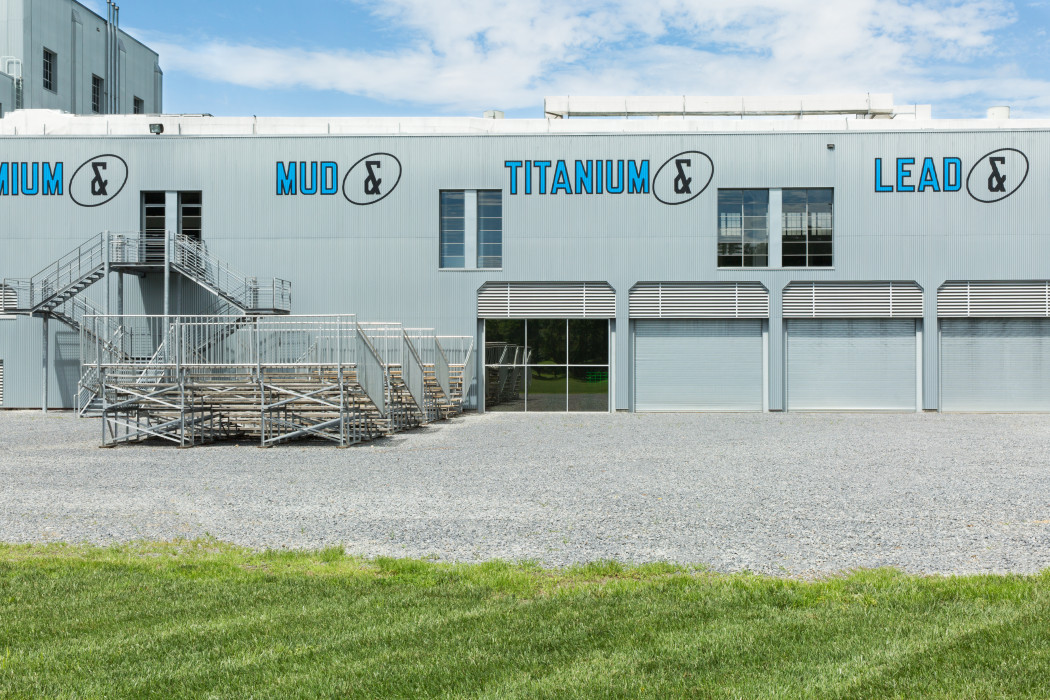
Weiner’s engagement with institutions was equally significant. His permanent installations at Dia:Beacon exemplify his capacity to create works that, while not dependent on a particular site, resonate deeply with their architectural context. In these spaces, his texts operate not merely as visual elements but as structuring devices that shape the viewer’s navigation and perception of the environment.
His Legacy
Weiner’s contribution to late twentieth-century art stands alongside that of Joseph Kosuth, On Kawara, and Sol LeWitt, establishing him as a foundational figure in the history of Conceptual art. His Statement of Intent became a foundational text for artists seeking to explore the dematerialisation of the art object, offering a clear and adaptable framework for thinking about the equivalence of conception and execution. By placing the idea at the centre of the work, Weiner proposed a model of art that was portable, reproducible, and capable of existing independently of any specific material form.
This emphasis on the mobility of ideas shaped the work of successive generations who engaged with language and instruction as artistic media, from Jenny Holzer’s illuminated public texts to Barbara Kruger’s politically charged slogans. More than five decades after Weiner first turned to language, his core proposition — that the conception of a work is sufficient for it to exist — remains deeply embedded in contemporary practice.

Mexico City Now: Artists, Galleries, and the Pulse of a Global Art Capital
Mexico City Now: Artists, Galleries, and the Pulse of a Global Art Capital
From Tradition to Form: Mexico’s Design Landscape Today